
 English
 Español
 русский
 Français
A mold quote for an aluminum die casting mold can swing by 30–50% for the same nominal part. The difference is rarely t...
READ MORE
Content
A purchasing engineer sends a 3D model of an aluminum controller housing and asks a simple question: how do you cast aluminum so the part is leak-tight, dimensionally stable, and repeatable at 20,000 pieces a year? The answer is not a single machine setting. Casting aluminum is a chain of decisions that starts with the part geometry and ends with inspection, and every link affects porosity, strength, surface finish, and cost per part.
The short answer is this: you cast aluminum by selecting a casting process, choosing an alloy that matches the part's mechanical and corrosion requirements, building a mold or die that controls filling and solidification, melting and treating the metal to a known quality, pouring or injecting it under controlled conditions, then trimming, machining, heat treating, and inspecting the result. For most automotive and equipment housings, high-pressure die casting is the production route. For low-volume or large structural parts, sand casting, gravity casting, or low-pressure casting may be more sensible.
That conclusion matters because buyers often ask for a quote before the process is fixed. A part that is easy to die cast may be difficult to sand cast at the same wall thickness, and a part designed for sand casting may need expensive changes before it can run in a steel die. The practical question is not "can aluminum be cast?" It is "which casting route gives the required properties at a viable tooling and piece price?"
Aluminum casting methods differ mainly in how the mold is made, how the metal fills the cavity, and how fast the part solidifies. Those differences control the achievable wall thickness, draft angle, surface finish, dimensional tolerance, tool life, and defect risk. A buyer should fix the process route before comparing supplier prices, because two quotes for the same part may assume different processes and different levels of post-processing.
For aluminum die casting, molten metal is injected into a reusable steel die at high velocity and high pressure. The die is costly, but the cycle is fast and the process is well suited to thin-wall housings, brackets, covers, and structural parts in medium to high volumes. Sand casting uses a expendable sand mold and gravity pouring. Tooling is cheaper, but cycle times are longer, tolerances are looser, and the surface is rougher. Gravity casting and low-pressure casting use a permanent metal mold, with low-pressure casting filling the cavity more gently and often producing denser parts. Investment casting uses a wax pattern and ceramic shell for fine detail and complex shapes, usually at a higher piece price.
| Process | Typical Use | What It Does Well | What to Watch |
|---|---|---|---|
| High-pressure die casting | Housings, covers, brackets, thin-wall parts | Fast cycles, good repeatability, thin walls | Tooling cost, porosity control, draft and gate design |
| Sand casting | Low volume, large parts, prototypes | Low tooling cost, flexible size | Rough surface, looser tolerance, more machining |
| Gravity permanent mold | Medium volume, thicker sections | Better surface than sand, reusable mold | Fill control, thermal fatigue of the mold |
| Low-pressure casting | Wheels, dense structural parts | Controlled filling, good density | Longer cycle, process discipline |
| Investment casting | Complex, small, high-detail parts | Fine detail, good surface | Higher piece cost, pattern and shell steps |
An experienced casting supplier should be able to explain why a route was chosen, not simply quote the route it already runs. If a part has 1.5 mm walls, deep pockets, and a tight flatness callout, the die casting route may be correct, but the gate location, overflow layout, and die thermal balance become critical. If the annual volume is only 500 pieces, a sand or gravity route may avoid a die investment that cannot be amortized.
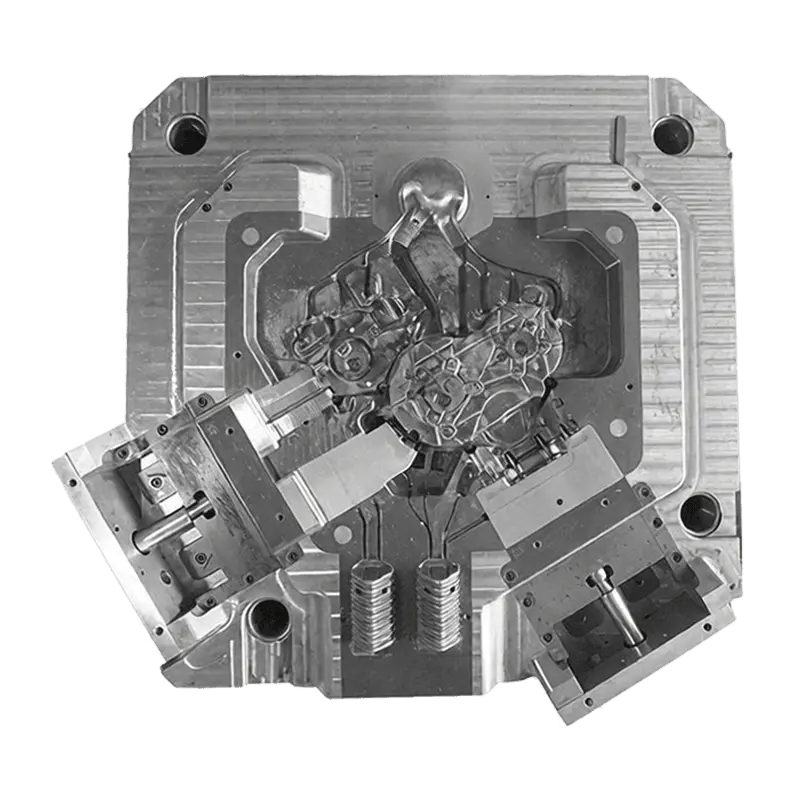 Custom Die Casting Molds for Automotive and New Energy PartsBrowse custom aluminum and magnesium high-pressure die casting molds for automotive, new energy, structural, telecom and other housings, with mold flow analysis before manufacturing.View Product →
Tooling is the bridge between the process choice and the production part. A mold designed for one process cannot simply be used in another, and a die that is cheap to build may cost far more in scrap, cycle time, and maintenance over its life.
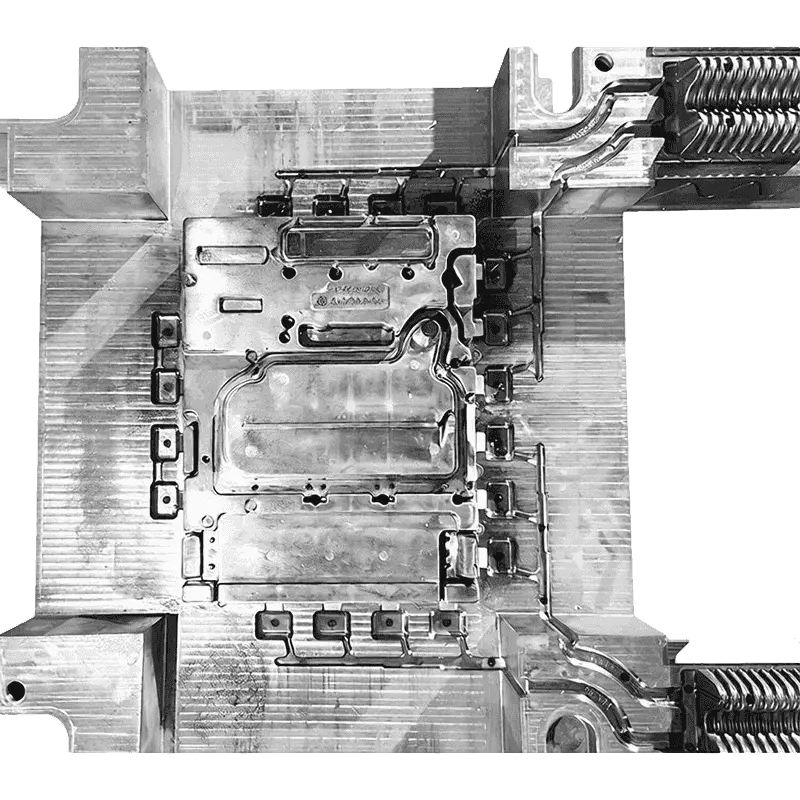
In high-pressure die casting, the sequence is usually: review the part and define the process, design the die and simulate filling and solidification, build the die, validate the first samples, set the melting and dosing parameters, inject the metal, cool and solidify the part, open the die and extract the casting, trim runners and overflows, then machine, finish, and inspect. The die is not just a shape. It is a thermal machine with gates, runners, overflows, cooling lines, ejector pins, and sliding cores that must work together.
For an aluminum housing, the die designer normally starts with the parting line, draft angles, wall thickness, and the location of machining stock. The gate must fill the cavity without jetting or cold shuts, while the overflows must capture cold metal and gas. Cooling lines must remove heat evenly, because uneven die temperature causes distortion, shrinkage porosity, and inconsistent dimensions. Ejector pins must push the part without marking critical surfaces. Slide mechanisms may be needed for undercuts, but every slide adds cost and maintenance risk.
Simulation is useful before steel is cut. Filling simulation can show where the metal front merges, where air may be trapped, and whether the gate velocity is too high. Solidification simulation can show isolated hot spots that will shrink and form porosity. A supplier that uses simulation well can often reduce trial shots and avoid a late die change. A supplier that treats simulation as a sales illustration rather than an engineering step will still discover the problems in the first article inspection.
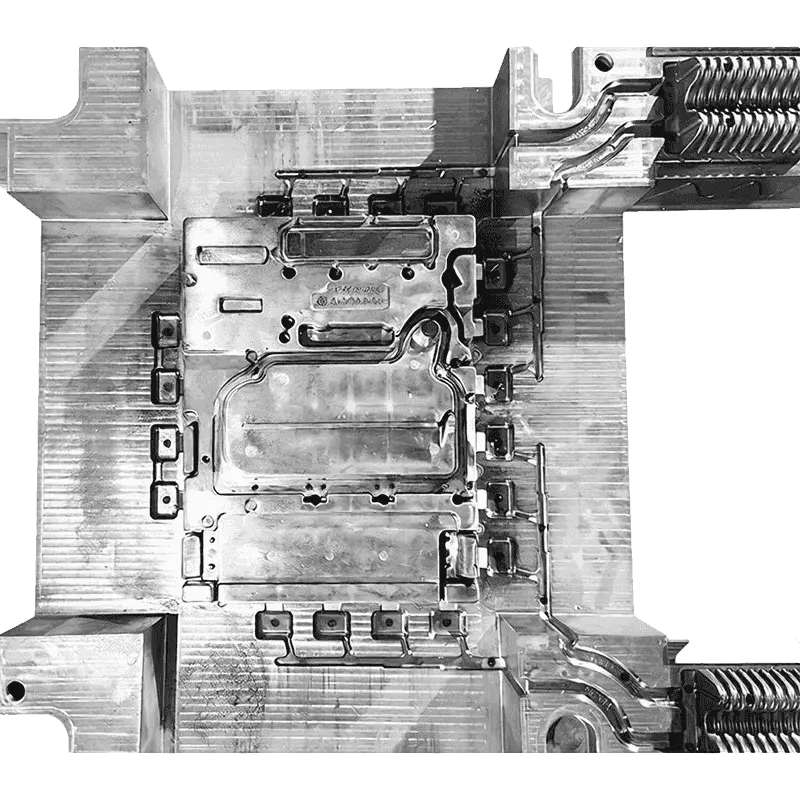 OEM/ODM Die Casting Mold for Automotive Controller HousingsAn OEM/ODM die casting mold for automotive controller housings, relevant when tooling decisions must connect simulation review with stable production control.View Product →
The production cycle then becomes a control problem. Metal temperature, die temperature, shot velocity, vacuum level, cycle time, and spray release agent all interact. A change in one parameter can fix a cold shut but create flash or soldering. That is why a stable die casting process is documented with a window, not a single set of numbers, and why the first article is only the beginning of process validation.
Aluminum casting alloys are selected for castability, strength, ductility, corrosion resistance, thermal conductivity, machinability, and heat treatment response. A380 and ADC12 are common high-pressure die casting alloys because they flow well, resist hot cracking, and produce good surface finish. They are widely used for housings, covers, and general structural parts. A356 is a common gravity and low-pressure casting alloy and can be heat treated for higher strength and elongation, but it is less suited to very thin-wall high-pressure die casting.
The alloy choice also affects the die and the finishing route. A die casting alloy with high iron content can reduce die soldering but may reduce ductility. A low-iron alloy may improve elongation but increase sticking risk. A heat-treatable alloy may require a solution treatment and aging step, which can add cost and may affect dimensional stability. If the part must be anodized, the alloy and surface condition matter because anodizing can reveal porosity, flow lines, and alloy segregation.
| Alloy Family | Common Route | Typical Strength and Ductility Balance | Practical Notes |
|---|---|---|---|
| A380 / ADC12 type | High-pressure die casting | Moderate strength, lower ductility than heat-treated alloys | Good castability, good for housings and covers |
| A356 type | Gravity, low pressure, sand | Higher strength and elongation after heat treatment | Better for structural parts, but process control is critical |
| Al-Si-Mg die casting alloys | High-pressure die casting | Improved strength where heat treatment is controlled | Watch blistering and dimensional change during heat treatment |
| Al-Mg type | Die casting and gravity | Good corrosion resistance, moderate strength | Can be more difficult to cast and machine |
For a buyer, the useful question is not "which alloy is best?" but "which alloy meets the drawing and the validation plan?" If the part is a structural bracket, elongation and fatigue matter. If it is a sealed electronics housing, leak tightness and dimensional stability may matter more than tensile strength. If the part will be powder coated, the alloy and surface finish must support the coating process. If it will be machined after casting, machinability and stable microstructure affect cycle time and tool wear.
It is also important to specify the alloy by a recognized standard and to require certified chemical composition and mechanical properties where needed. A vague callout such as "aluminum alloy" leaves too much room for substitution. The drawing should state the alloy, temper, casting process, critical dimensions, porosity acceptance criteria, and any special inspection requirements.
Most casting problems are designed into the part or the die before the first shot. A wall that is too thin may not fill. A thick section next to a thin section may create a hot spot and shrinkage porosity. A sharp internal corner may concentrate stress and cause cracking. A deep pocket may need a slide that is difficult to vent. A machining stock allowance that is too small may not clean up, while an allowance that is too large may remove the dense skin and expose porosity.
Good die design starts with a conversation between the part designer and the casting engineer. The casting engineer will usually ask for uniform wall thickness, generous fillets, adequate draft, and a parting line that keeps the die simple. The designer may need to adjust bosses, ribs, and mounting pads to avoid isolated heavy sections. If the part is a sealed housing, the gasket groove and sealing surface need special attention because porosity or distortion in those areas can cause leaks that are expensive to find later.
Simulation should be used to test the filling pattern, air entrapment, solidification sequence, and thermal balance. It can also help compare gate locations and overflow layouts before the die is cut. However, simulation is only as good as the inputs. The alloy properties, die temperature, shot profile, and boundary conditions must reflect the actual process. A simulation that assumes ideal conditions may look good and still fail in production.
For thin-wall aluminum castings, vacuum assistance is often used to reduce air entrapment. High-vacuum die casting can improve density and allow better surface quality in shell products, but it also demands good die sealing and process discipline. The technology is not a substitute for proper gate design. It is an additional control that works when the die and machine are set up correctly.
Buyers should ask for the die layout, the simulation results, and the process control plan before approving tooling. They should also ask how the supplier will handle engineering changes. A die change after the first article can be expensive, and some changes may require welding, insert replacement, or even a new die block. It is cheaper to resolve the geometry and filling strategy before steel is cut.
Aluminum is reactive at melt temperature. Hydrogen can dissolve into the liquid metal and later form porosity as the casting solidifies. Oxide films can be folded into the metal during transfer and fill the part with inclusions. Dross and sludge can build up in the furnace if the melt is not managed. These problems do not always show on the surface, which is why melt quality is a critical but often invisible part of casting aluminum.
A controlled melt practice usually includes clean charge material, controlled furnace temperature, degassing or fluxing to reduce hydrogen, grain refinement, and sometimes filtration. The transfer ladle and launder should be clean and preheated. The metal should not be overheated, because high temperature increases hydrogen pickup and oxidation. It should not be too cold, because cold metal can cause misruns and cold shuts. The right temperature window depends on the alloy and the process, but the point is that it must be measured and controlled, not judged by eye.
For high-pressure die casting, the shot chamber and plunger also matter. A worn plunger tip can allow air into the shot chamber. A poorly lubricated shot sleeve can create gas or cold metal. A dosing delay can cause the metal to lose temperature before injection. These details are part of the process window and should be checked during setup and monitored during production.
Die temperature is equally important. A cold die can cause cold shuts, poor surface finish, and high thermal stress on the die. An overheated die can cause soldering, excessive flash, and long cycle times. The die cooling system must be balanced, and the spray release agent must be applied consistently. In production, a stable die thermal profile is often the difference between a robust process and one that needs constant adjustment.
During filling, the metal must reach the far end of the cavity before it freezes. The gate velocity must be high enough to fill thin walls but not so high that it atomizes the metal and traps air. The overflow and venting system must allow air to escape. In a well-designed die, the metal front progresses smoothly, and the last areas to fill are fed with hot metal and connected to overflows.
During solidification, the part shrinks as it cools. If a heavy section is isolated from the feed path, a shrinkage cavity or porosity can form. The die designer may add a biscuit or runner that stays molten longer and feeds the casting, or may adjust cooling to promote directional solidification. In high-pressure die casting, intensification pressure is applied after the cavity is full to compress the metal and reduce porosity. The timing and level of that pressure must be set correctly, because too little pressure leaves porosity and too much pressure can flash the die.
Porosity is not a single defect. It may be gas porosity from trapped air or hydrogen, shrinkage porosity from feeding problems, or inclusion-related porosity from oxide films. Each has a different cause and a different fix. A supplier that treats all porosity the same way may try to solve a gas problem with more pressure or a shrinkage problem with more venting, and the defect will persist.
For a critical sealed housing, the location of porosity can matter as much as the total amount. A small pore in a non-sealing area may be acceptable, while the same pore in a gasket groove or oil passage may cause a leak. That is why porosity acceptance should be defined by function and location, not just by a single percentage. X-ray, CT scanning, leak testing, and destructive sectioning can all be used, but the inspection method should match the risk.
High-vacuum die casting and vacuum-assisted filling are useful when air entrapment is the main risk. They can improve density in shell products and allow thinner walls, but they cannot fix a bad gate design or a cold melt. The process must be integrated with die design, shot profile, and die thermal control.
The related technical article on high-vacuum die casting technology in shell products is a useful reference for teams evaluating sealed housings and thin-wall shells.
After the casting cools, it usually goes to a trim die or saw to remove the biscuit, runners, and overflows. The trim tool must be aligned with the die, or it can bend the part or leave a rough edge. Some castings then go through shot blasting or tumbling to remove flash and improve surface appearance. Others go directly to machining, where fixtures must hold the part without distorting it.
Machining is often the largest variable cost after casting. A stable casting with consistent machining stock allows high cutting speeds and predictable tool life. A casting with excessive draft, flash, or distortion may need more setup time, more clamping force, and more inspection. For aluminum, cutting tools should be designed for the alloy's tendency to stick and build up on the edge. Coolant, tool geometry, and fixture rigidity all affect surface finish and dimensional capability.
Surface treatment is selected for corrosion protection, appearance, electrical insulation, or wear resistance. Powder coating and painting are common for visible parts. Anodizing is used where a hard, decorative, or corrosion-resistant surface is needed, but it can reveal porosity and flow lines. E-coating can provide uniform coverage on complex shapes. Plating is less common on aluminum castings but may be used in specific applications. In every case, the casting surface must be clean and consistent, and the pretreatment must be compatible with the alloy.
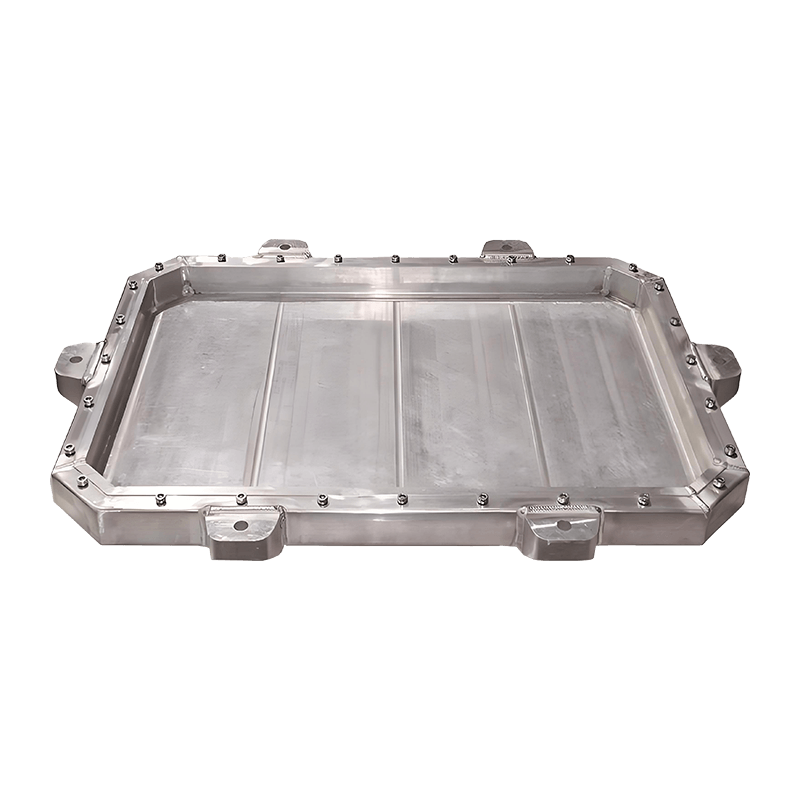 OEM/ODM Aluminum Battery Tray for New Energy VehiclesOEM/ODM aluminum battery tray for new energy vehicle battery systems, a core structural part where lightweighting and downstream assembly planning matter.View Product →
Large structural parts such as battery trays show why post-casting operations must be planned early. The part may need machining on mounting surfaces, friction stir welding or adhesive bonding, leak testing, and a protective coating. If the casting is distorted, the downstream fixture and welding process will struggle. If the casting has porosity in a weld zone, the weld may fail inspection. The casting process and the assembly process cannot be designed in isolation.
A supplier's quality system is a starting point, not a guarantee. For automotive work, IATF 16949 certification indicates that the supplier has a quality management system aligned with automotive requirements. ISO 9001 covers the broader quality system. These certificates are useful, but the buyer should still review the control plan, process flow diagram, failure mode analysis, inspection standards, and calibration records for the specific part.
The first article inspection should go beyond dimensions. It should include material certification, chemical composition, mechanical properties if required, porosity evaluation, leak testing, surface inspection, and a review of critical features. For a housing, the first article should also verify flatness, bore position, thread capability, and sealing surface roughness. For a structural part, it may include X-ray or CT scanning, tensile testing, and fatigue or crash-related validation.
Gauge repeatability and reproducibility matter as well. A dimension that cannot be measured consistently cannot be controlled in production. The supplier should agree with the customer on datum schemes, inspection methods, sampling frequency, and reaction plans. If a critical characteristic is out of specification, the supplier should know whether to stop production, segregate parts, rework, or scrap. A good quality plan is specific, not a generic statement that "all parts will meet the drawing."
Process capability should be reviewed after a stable production run, not just from a handful of first articles. A process that makes three good samples may still fail at volume if the die temperature drifts, the metal quality changes, or the machining fixture wears. Buyers should ask for capability studies on critical dimensions and defect rates over a meaningful production run.
Integrated suppliers that control mold design, casting, machining, and inspection can often shorten the feedback loop between the die and the finished part. That does not replace the need for objective inspection, but it reduces the chance that one supplier blames another when a problem appears. Clear drawing requirements and a shared measurement plan are still essential.
The cost of an aluminum casting is made up of metal, melting and holding, die or mold amortization, casting cycle time, trim, machining, finishing, inspection, packaging, and scrap. A quote that looks low on piece price may hide a high tooling cost, a low yield, or a machining allowance that drives extra operations. A quote that looks high may include a robust die, better process control, and a lower total cost over the program.
Volume is the main driver of process economics. High-pressure die casting needs a die that can cost tens of thousands of dollars or more, depending on size, complexity, and number of slides. That die must be amortized over the program volume. If the annual volume is low, the piece price may be uncompetitive even if the die is cheap. Sand casting and gravity casting have lower tooling costs but higher labor and cycle time, which can be attractive for prototypes, low-volume equipment, and large parts.
Tool life is another cost factor. A die for aluminum die casting may last tens of thousands to hundreds of thousands of shots depending on alloy, die steel, heat treatment, cooling, and maintenance. A die that runs too hot or lacks proper cooling may crack early. A die that is not cleaned and maintained may produce flash, soldering, and dimensional drift. Buyers should ask about die maintenance intervals, spare inserts, and the supplier's policy for tooling ownership and wear.
Scrap and rework are often underestimated. A casting that needs extra machining to clean up a warped surface may have a low scrap rate at casting but a high cost at machining. A casting that leaks after assembly may pass dimensional inspection and still fail in service. The true cost includes the cost of finding and containing defects, not just the cost of making the part.
For a program with uncertain volume, it may be wise to start with a lower-cost process for prototypes, then move to die casting once the design is stable. But the part should be designed for the intended production process from the beginning. A prototype casting that is very different from the production casting may not reveal the real manufacturing risks.
Most aluminum casting defects have a process cause. Porosity may come from gas, shrinkage, or inclusions. Cold shuts occur when two metal fronts meet without fusing. Misruns occur when the metal freezes before filling the cavity. Cracks may come from thermal stress, ejection strain, or alloy choice. Soldering occurs when aluminum sticks to the die surface. Dimensional problems may come from die temperature, ejection, machining stress, or heat treatment.
| Defect | Likely Area to Check | Practical Impact |
|---|---|---|
| Gas porosity | Melt quality, shot profile, venting, vacuum | Leak paths, weak sections, poor machined finish |
| Shrinkage porosity | Wall thickness transitions, feeding, die cooling | Internal voids in heavy sections |
| Cold shut | Fill pattern, metal temperature, die temperature | Weak surface, cosmetic reject, crack initiation |
| Flash | Die fit, locking force, injection pressure | Extra trim, dimensional variation, die wear |
| Soldering | Die temperature, release agent, alloy, surface finish | Die damage, rough surface, downtime |
| Distortion | Ejection, cooling, machining stress, heat treatment | Flatness and assembly problems |
The right response is to measure the defect, locate it, and correlate it with process data. If porosity appears in the same region shot after shot, it is likely a die or solidification issue. If it moves around, it may be a melt or shot stability issue. If it appears only after machining, the casting may have a subsurface defect that was not visible before. A disciplined problem-solving process is more valuable than a list of generic fixes.
A useful casting quote needs more than a 3D model. The supplier should receive the 3D part data, 2D drawing with tolerances and critical characteristics, alloy and process requirements, annual and monthly volumes, surface finish and cosmetic requirements, machining and assembly scope, inspection and validation requirements, packaging and shipping terms, and any target piece price or tooling budget. If the part is not yet finalized, it helps to send the design intent, loading conditions, sealing requirements, and expected production process.
The buyer should also state what is not negotiable. If a sealing surface must be machined after casting, say so. If the part must be leak-tight at a certain pressure, state the test method and acceptance limit. If the part will be powder coated, state the color and appearance standard. If the part will be welded or bonded, state the process because casting porosity and alloy choice can affect weldability and bond strength.
A good supplier will respond with assumptions, not just a price. It should identify the proposed process, alloy, die layout, number of cavities, machining strategy, inspection plan, tooling lead time, and sample timeline. It should also flag risks such as thin walls, undercuts, tight tolerances, or unclear acceptance criteria. Those questions are a sign of engineering engagement, not a reason to avoid the supplier.
For buyers who want to discuss a specific part, the contact page is the practical starting point. A short technical review before quoting can save weeks later, especially when the part is a sealed housing or a structural component with tight flatness and porosity requirements.
An integrated supplier that designs and builds the die and also runs the casting and machining process can reduce the handoff risk between tooling and production. The same team that simulated the fill can adjust the die, set the process window, and inspect the first article. That does not automatically make the part easy to cast, but it does shorten the feedback loop when a problem appears.
Ningbo Dinghong Mould Co., Ltd. is an example of that model. The company is based in Ningbo, Zhejiang, near Beilun Port, and describes itself as integrating mold design, mold manufacturing, die casting, precision machining, and trade. Its product scope includes die casting molds and aluminum alloy die castings for automotive, appliance, communication, photovoltaic, energy storage, charging, robot, fitness equipment, pump and valve, and other applications. The company states that it has served the automotive industry and OEM customers and that it passed ISO 9001 and IATF 16949 certification in 2017.
For a buyer, the value of an integrated supplier is not just convenience. It is accountability. If the casting has a filling problem, the die design is part of the same scope. If the machined part has a locating issue, the casting datum and fixture design can be reviewed together. If the part needs a design change, the tooling and process impact can be assessed in one conversation.
The company's mold portfolio includes automotive controller housing molds and gear chamber molds, which reflect the type of aluminum shell work common in vehicle and equipment applications. Its casting portfolio covers fuel automotive parts, new energy vehicle parts, three-electric parts, structural parts, motorcycle parts, pump and valve parts, fitness equipment parts, communication equipment parts, photovoltaic and energy storage parts, electrical parts, robot parts, and other parts. That breadth is useful when a buyer needs a supplier that can handle both a die and a production part without splitting responsibility across multiple vendors.
None of this removes the need for a clear specification. An integrated supplier still needs the drawing, volume, alloy, tolerance, finish, and validation requirements. The advantage is that the engineering conversation can happen in one place, with the die designer, casting engineer, and quality team looking at the same part and the same risk.
If you need to audit how a supplier casts aluminum, look for a sequence that is visible in documents and on the floor. The exact steps vary by process, but the logic should be consistent:
The buyer's role is to make the requirements explicit and to verify that the supplier's process can meet them repeatedly. The supplier's role is to control the variables that affect filling, solidification, and final machining. When both sides do that, casting aluminum becomes a predictable manufacturing process rather than a series of surprises.
The best casting projects start with the right question. Instead of asking only "how do you cast aluminum," ask "which casting route, alloy, die design, and inspection plan will make this part reliable at the volume we need?" The answer should be specific to the part, the process window, and the acceptance criteria. A supplier that can explain that answer clearly, and show the tooling and quality evidence behind it, is usually a better partner than one that quotes the lowest piece price without discussing the risks.

A mold quote for an aluminum die casting mold can swing by 30–50% for the same nominal part. The difference is rarely t...
READ MOREDie casting automotive parts are made by forcing molten metal into a steel mold under high pressure, where it fills t...
READ MORETwo quotations for the same aluminum controller housing can differ by 20% or more, even when both suppliers list the sa...
READ MOREA 12-week die casting mold build can look competitive on quote and still become the expensive option if the first trial...
READ MORE

Sun Yuejun: +86-13806631860
Wang Shiyong: +86-15958891460 / 15058297768
Dove Yao: +86-18625086675


Copyright © Ningbo Dinghong Mould Co., Ltd. Rights Reserved. Custom Precision Die Casting Aluminum Alloy Parts Manufacturers
