
 English
 Español
 русский
 Français
A 12-week die casting mold build can look competitive on quote and still become the expensive option if the first trial...
READ MORE
Content
A mold quote for an aluminum die casting mold can swing by 30–50% for the same nominal part. The difference is rarely the cavity count alone. Tool life, thermal balance, steel grade, cooling layout, and the supplier’s ability to control the process after the mold arrives decide whether that quote becomes a low-cost tool or an expensive lesson. If you are buying an aluminum die casting mold, treat it as a production asset, not a machined block of steel. The right question is not “What is the lowest tool price?” but “What part quality, cycle time, and maintenance cost will this mold deliver over 100,000 to 500,000 shots?”
This guide explains the practical factors that separate a mold that runs quietly for years from one that creates flash, porosity, soldering, and unplanned downtime. It focuses on aluminum die casting molds for automotive, new energy, communications, and similar shell or structural parts, where wall thickness, dimensional tolerance, and surface requirements are tight enough that tooling decisions show up quickly in the scrap rate.
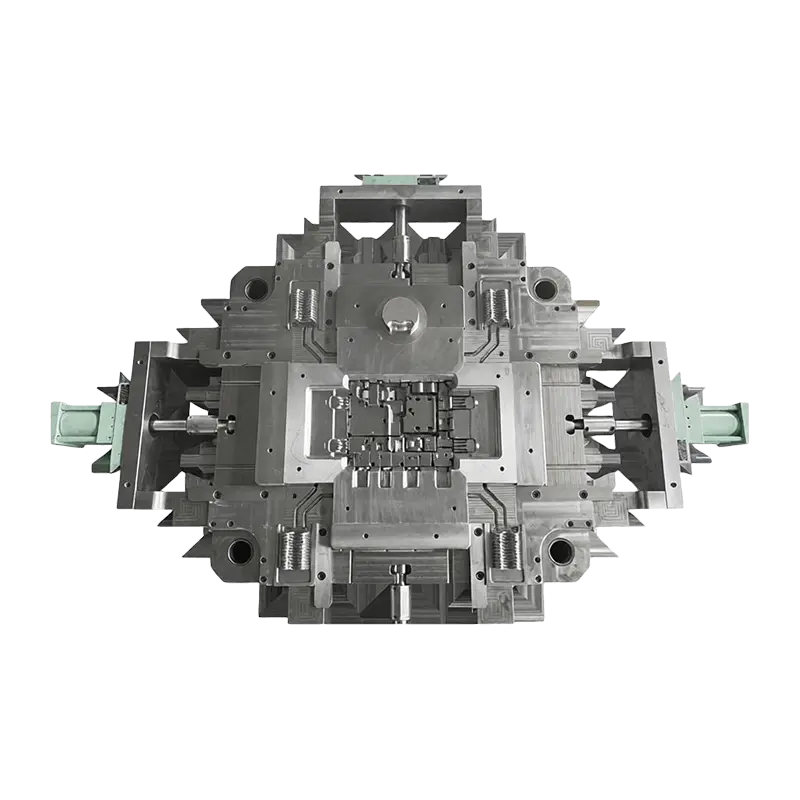
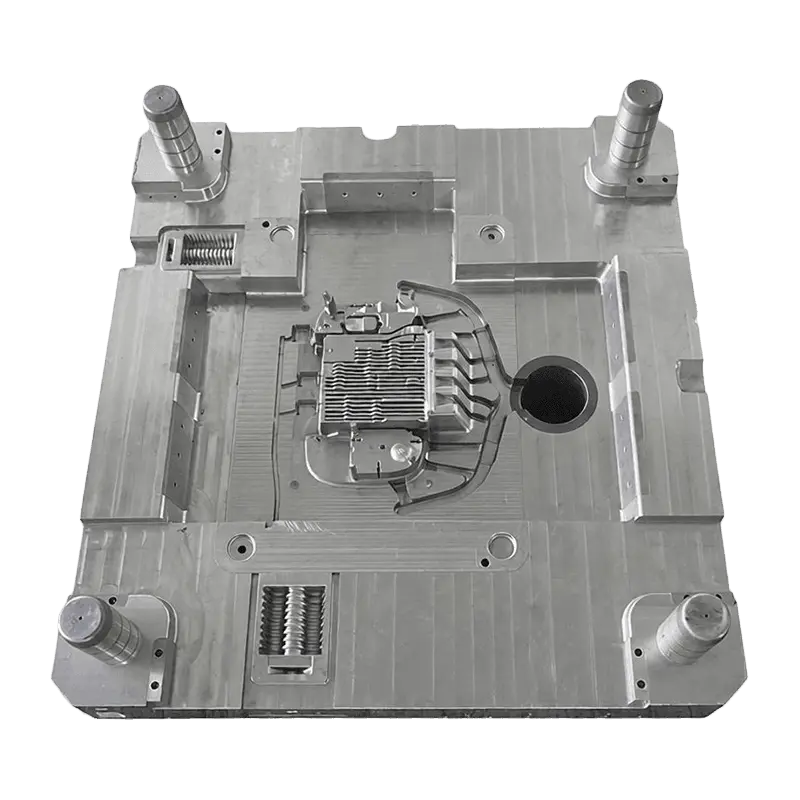
An aluminum die casting mold is a high-pressure, high-temperature forming tool. Molten aluminum enters the cavity at 650–700°C and often at 30–80 m/s gate velocity, then solidifies in seconds under 500–1,200 bar intensification pressure. The mold must withstand thermal fatigue, erosion, soldering, and mechanical stress while holding cavity dimensions and parting-line integrity. That is why mold life is a system property. It depends on steel selection, heat treatment, cavity design, cooling, venting, surface treatment, and the die casting machine’s process window.
For a buyer, the mold’s job can be summarized in four outcomes: fill the cavity completely before solidification blocks flow; remove heat at a controlled rate so shrinkage porosity and hot cracks stay within acceptance limits; eject the part without distortion or sticking; and survive repeated cycles with predictable maintenance. A tool that misses any one of these will push cost into scrap, rework, or premature retooling. The die casting part and mold process is not linear: gate design affects cooling, cooling affects cycle time, and cycle time affects tool life.
Ask for the mold design assumptions, not only the mold price. The most useful assumptions cover shrink factor, draft angle, parting line, ejector layout, thermal balance, and expected tool life. If those are missing, the comparison is incomplete.
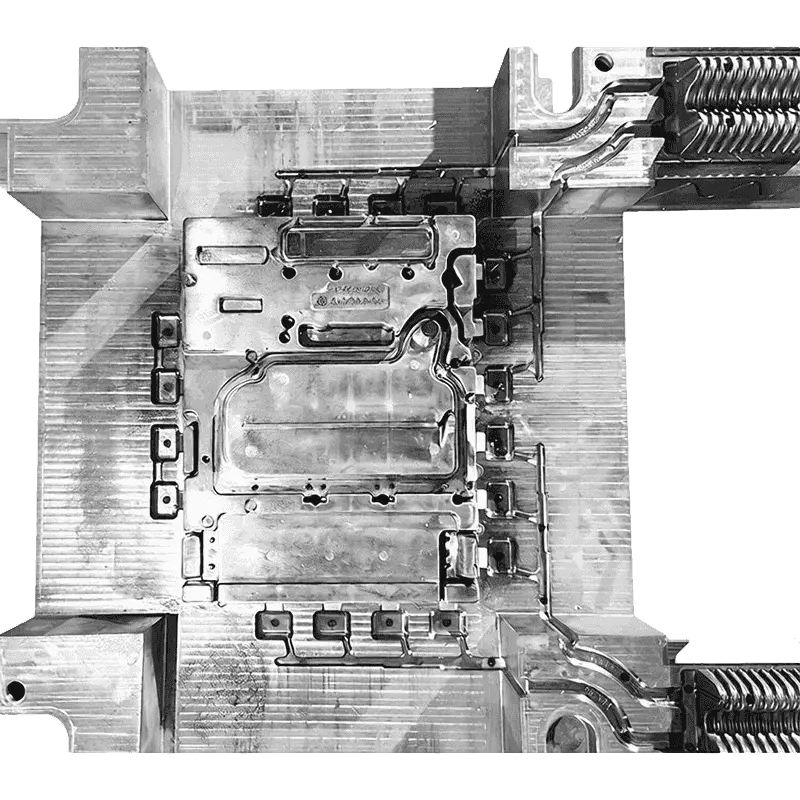
Most aluminum die casting mold problems begin in the design review. A cavity layout that looks compact on a 2D drawing may create hot spots, long flow paths, or weak steel sections. The following table summarizes the decisions that matter most during quoting and design approval.
| Design factor | What to check | Effect if poorly chosen |
|---|---|---|
| Parting line | Flashing risk, slider and insert access, venting path | Flash, high trim cost, difficult maintenance |
| Gate and runner | Gate area, velocity, flow balance, overflow placement | Cold shuts, porosity, die erosion, scrap |
| Cooling layout | Distance to cavity, baffle or bubbler use, thermal mapping | Hot spots, long cycle, soldering, dimensional drift |
| Ejection | Ejector pin size and position, draft, ejection force | Sticking, distortion, cracked bosses, downtime |
| Shrink factor | Alloy-specific shrink, wall thickness, constrained areas | Dimensional rejection and fit issues |
| Steel and inserts | H13 or equivalent, hardness, hot work rating, insert strategy | Early heat checking, erosion, costly replacement |
In practice, gate and cooling decisions have the strongest influence on both part quality and tool life. A slightly larger gate can reduce porosity but may increase flash and require more trimming. A cooling line placed too close to the cavity can cool the steel quickly, but it can also create a steep thermal gradient that promotes heat checking. Experienced mold designers use simulation and past shot data to balance these trade-offs before cutting steel.
The mold material is not just a grade name. Two H13 tools can behave differently if melting practice, forging reduction, heat treatment, and hardness uniformity differ. For aluminum die casting, common choices include H13, SKD61, 1.2344, and sometimes specialized hot-work steels. Premium steel costs more upfront, but it can extend tool life and reduce polishing downtime. On high-volume automotive programs, a 10–20% steel cost increase may be justified if it prevents an unplanned mold repair during peak production.
Heat treatment is equally important. A hard, brittle tool may crack; a soft tool may wash out at the gate. The target is usually not maximum hardness but balanced hardness and toughness, with adequate tempering to resist thermal fatigue. Surface treatments such as nitriding or coating can help with soldering and erosion, but they do not replace proper cooling or gate design. Buyers should request hardness reports, steel certificates, and a heat-treatment record. Those documents are not paperwork—they are the traceable basis for warranty discussions if the mold fails early.
A good mold is designed together with its process window. Simulation helps predict fill, solidification, air entrapment, and hot spots, but simulation is only as good as the inputs: alloy properties, wall thickness, gate area, die temperature, and machine performance. A supplier that runs filling and solidification studies before cutting steel can reduce trial shots and avoid expensive weld corrections. That does not mean every mold needs a complex simulation; it means the design team should be able to explain why the gate, runner, overflow, and cooling layout will work.
During sampling, the focus should be on stable parameters, not one good shot. Check cavity pressure, intensification, shot velocity, die temperature, and cooling flow. A mold that produces acceptable parts only in a narrow window will be fragile in mass production. A robust mold produces acceptable parts across a practical range and recovers quickly after short stops. For programs with tight porosity or leak requirements, vacuum-assisted die casting, squeeze pins, or local cooling may be needed. These choices should be decided at the mold design stage because retrofitting them later is slower and more expensive.
Aluminum die casting mold acceptance should be tied to part requirements, not only mold dimensions. The first article inspection should cover critical dimensions, porosity, surface finish, and fit-up. For automotive or new energy parts, additional checks may include X-ray, leak testing, CT scanning, or mechanical testing. The mold itself should be verified for cavity dimensions, parting-line contact, ejector function, cooling circuit flow, and safety systems. A clean acceptance report protects both sides because it defines what “good” means before volume production begins.
Supplier verification goes beyond ISO certificates. Ask how the mold shop controls electrode wear, EDM recast layers, polishing direction, and deep-rib machining. Those details affect venting, heat checking, and part release. Also ask how the die caster tracks mold maintenance: shot count, polishing intervals, insert replacement, and spare-part strategy. A mold without a maintenance plan may still run, but it will not run predictably. For projects that combine tooling and part supply, a supplier with in-house die casting molds and casting capacity can shorten the learning curve between mold approval and stable production.
Buyers often split mold purchase from part production to create competition. That can work, but it adds interface risk. The mold maker may optimize for tool build, while the die caster may struggle with a mold that does not match its machine, cooling system, or process capability. An integrated supplier can design the mold around the actual die casting machine, alloy, and finishing line. That reduces finger-pointing when a dimensional issue appears after sampling.
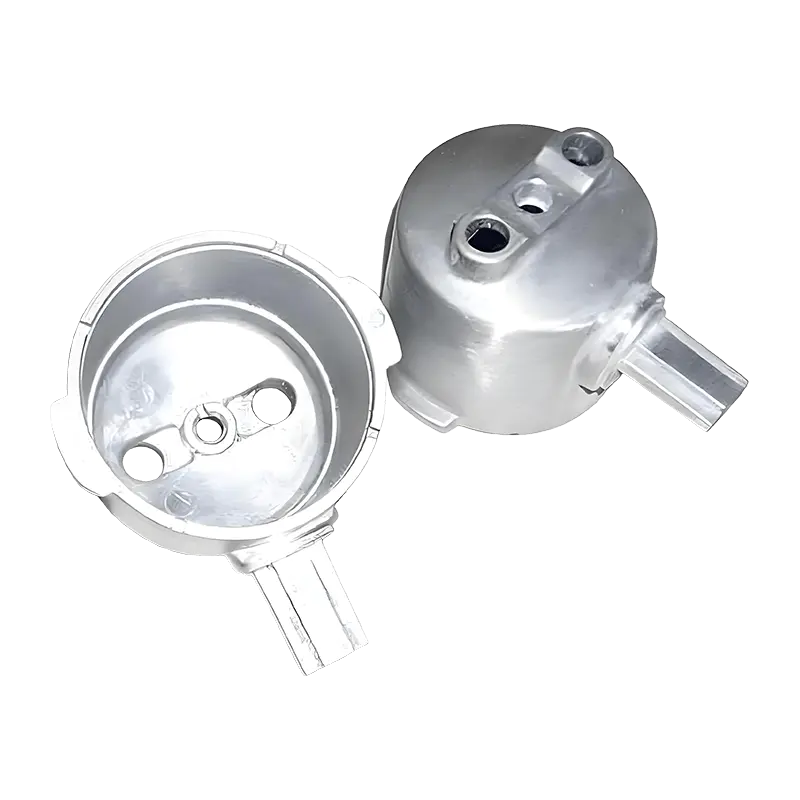
For automotive controller housings, gear chambers, and similar shell parts, the mold is only one part of the cost equation. Cycle time, scrap rate, machining allowance, and tool maintenance are usually larger over the program life. A mold designed for easier venting and thermal balance may cost slightly more than a basic tool, but it can lower cost per good part. If a program includes structural parts such as battery trays or longitudinal beams, the mold must handle larger shot weights, longer flow paths, and tighter flatness requirements. That usually calls for more robust cooling, stronger ejection, and careful venting.
 OEM/ODM Die Casting Mold for Automotive Controller HousingsPage presents an OEM/ODM die casting mold for automotive controller housings, suited for evaluating tooling needs around venting, cooling, and cost per good part.View Product →
New energy vehicles have pushed aluminum die casting molds toward larger, thinner, and more integrated parts. Battery trays, motor housings, electronic control units, and reducer housings often require high dimensional stability, leak tightness, and thermal management. These parts are less tolerant of porosity and deformation than many traditional covers. Mold design must account for gating that avoids air entrapment in long flow paths, cooling that controls warpage, and ejection that does not distort thin walls.
Lightweight structural parts add another layer. A shock tower or longitudinal beam may replace several steel stampings, so the mold must deliver consistent mechanical properties and fit-up. That means the die caster needs a robust process window and the mold needs durable inserts, effective venting, and a maintenance plan matched to higher shot weights. Buyers should ask for simulation results, sampling reports, and a dimensional capability study before releasing volume orders. The lowest-cost mold is rarely the lowest-cost program when structural safety and scrap are included.
 Die Casting Battery Tray for New Energy Vehicles OEM/ODMPage presents an OEM/ODM aluminum battery tray for new energy vehicles, a core battery-system structural component; useful when reviewing lightweight integrated die-casting needs.View Product →
Aluminum die casting molds for communications equipment, such as filter housings and heat sink cavities, have different priorities. These parts often need good thermal conductivity, EMI-related geometry, and consistent surface quality for assembly. Wall sections may be thin, and flatness can matter for sealing or mounting. A mold that produces a good sample but varies with die temperature will create assembly problems. Cooling layout and venting are therefore just as important as cavity machining accuracy.
Consumer and industrial parts, including baking trays, coffee machine handles, fitness equipment handles, pump housings, and robot components, tend to have moderate tolerances but high cosmetic expectations. Polishing, surface texture, and ejection marks can decide whether a part is accepted. In these projects, the mold steel and polishing process affect cost more than high-end simulation. Still, the same rule applies: define the cosmetic and functional acceptance criteria before cutting steel. A mold built for one specification may not meet another, even if the cavity geometry is identical.
 Die Casting Telecommunication Filter Housing OEM/ODMPage presents an OEM/ODM die-cast telecommunication filter housing for 5G equipment; useful for reviewing signal-filtering housing needs and cosmetic acceptance criteria.View Product →
Before issuing a purchase order, align the technical and commercial sides of the mold. The goal is not to add bureaucracy; it is to prevent the three most common failures: an undersized tool for the press, a cooling layout that cannot hold cycle time, and a maintenance plan that assumes perfect production. A practical checklist can be reviewed in one meeting.
If a supplier cannot answer these points in specific terms, the mold quote is not comparable. A low price with vague technical assumptions often creates change orders, delayed sampling, and higher part cost. If you need to compare tooling options, start with the mold design and process assumptions, then compare price.
An aluminum die casting mold succeeds when it is treated as part of a production system. Steel grade, heat treatment, gating, cooling, venting, ejection, simulation, and maintenance all interact. The best buying decision is not the cheapest tool or the fastest delivery; it is the mold that reaches stable production with the fewest surprises and the lowest total cost per accepted part. For programs that combine tooling and castings, choose a supplier that can explain the process window, show traceable quality records, and support the mold after the first sample. That is how a mold becomes an asset rather than a repair item.


A 12-week die casting mold build can look competitive on quote and still become the expensive option if the first trial...
READ MOREDie casting is a metal forming process that injects molten metal into a steel mold under high pressure, then holds that...
READ MOREA 180 g aluminum housing with 1.8 mm walls and a ±0.10 mm bearing bore is quoted in the same week as a 12 g stainless s...
READ MORETwo aluminum housings reach the same leak-test bench on the same afternoon. Both meet the drawing, both weigh close to ...
READ MORE

Sun Yuejun: +86-13806631860
Wang Shiyong: +86-15958891460 / 15058297768
Dove Yao: +86-18625086675


Copyright © Ningbo Dinghong Mould Co., Ltd. Rights Reserved. Custom Precision Die Casting Aluminum Alloy Parts Manufacturers
